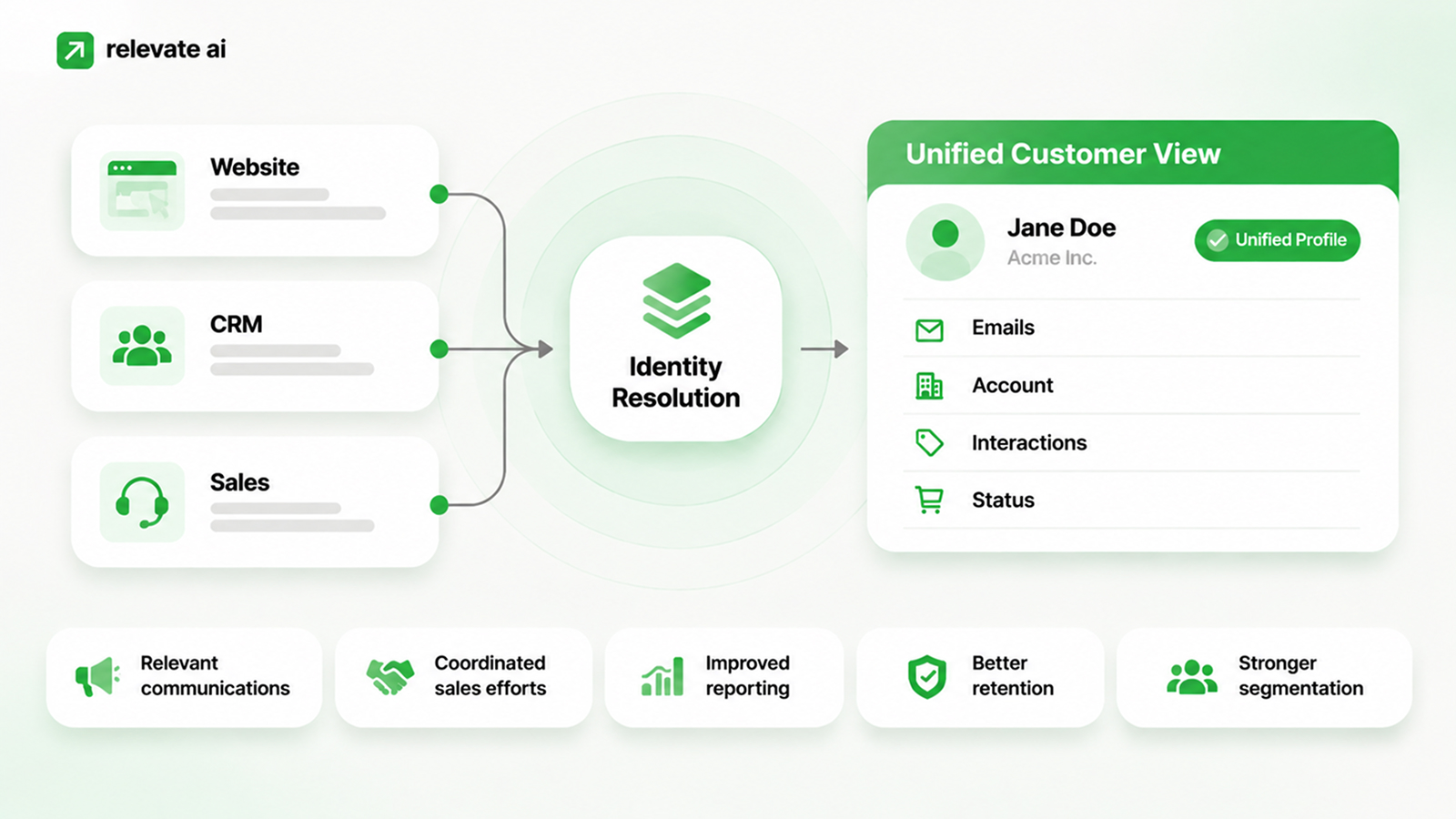

A customer may appear as three separate records inside one business: a website visitor using a personal email, a buyer listed under a work address in the CRM, and an account contact entered by a sales representative. Each system holds part of the relationship, but none shows the complete picture.
This fragmented information makes it harder to understand customer needs, coordinate sales and marketing activities, measure performance and identify growth opportunities.
What is the Identity Resolution?
Identity resolution is the process of identifying and connecting records that belong to the same person, business or account across different systems. It helps organizations reduce duplicate records and create a more consistent customer view for sales, marketing and analytics.
Why Does Customer Data Become Fragmented?
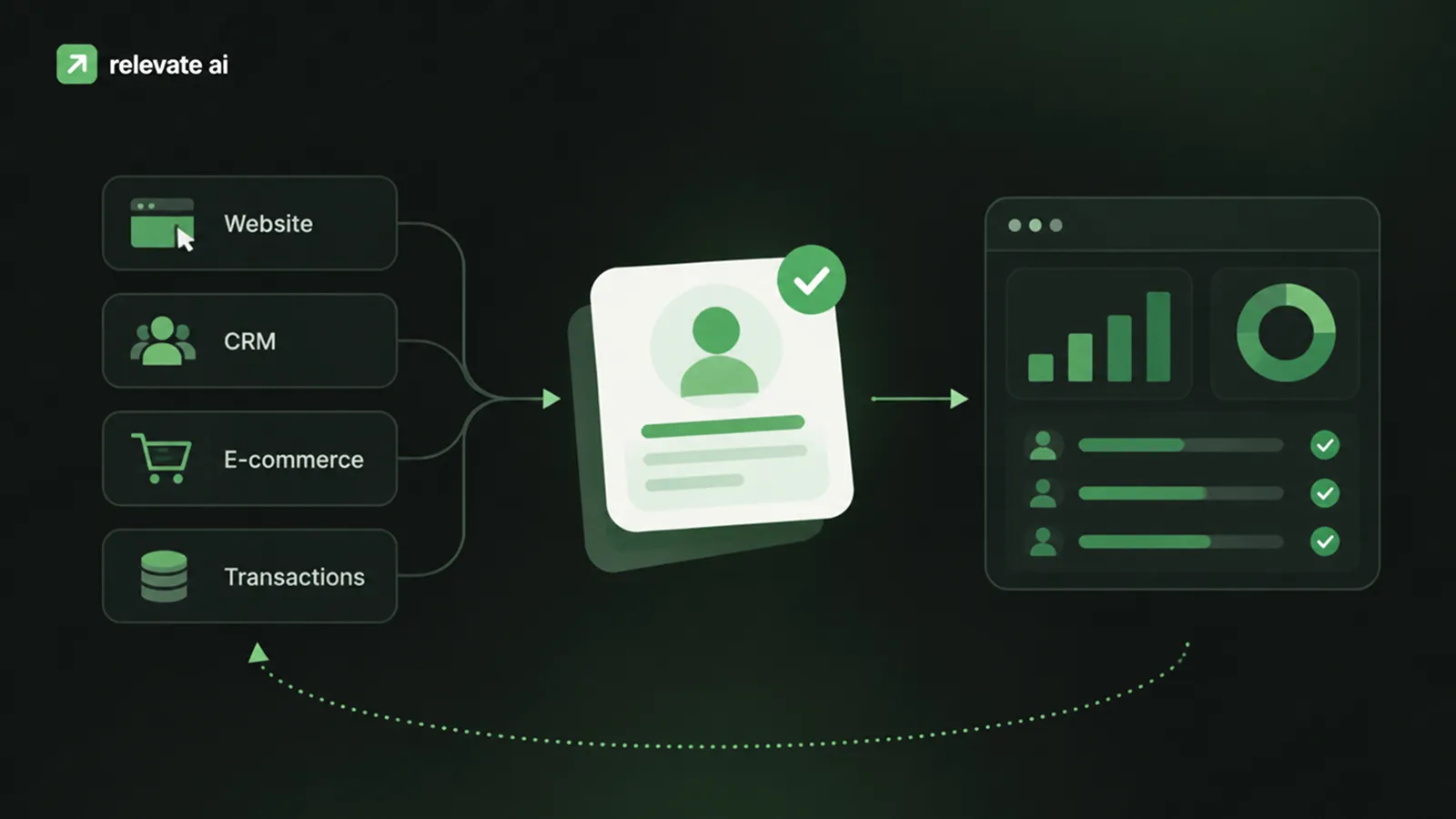
Organizations gather customer data through CRM systems, e-commerce sites, websites, email campaigns, helpdesk services and transactional systems.
Such platforms may work independently and gather various pieces of information.
Customers can have several emails, various forms of their names, individual account IDs, etc. Website activity may remain disconnected from an existing customer record.
These gaps create practical problems. Marketing sends an acquisition offer to an existing customer. Sales representatives may overlook established relationships because an account appears under another name. The reports can have duplicate entries counted as unique customers for analysis of campaigns and revenue.
How is Identity Resolution Done?
Identity resolution uses the comparison of the identifiers and attributes that are important across the connected sources to find out whether the records belong to the same individual. The process can be done through the following four steps.
1. Connecting the sources of the relevant data
Connecting the first party data from such sources as CRM, sales, marketing, e-commerce and transactional data. This makes sure that the relevant records are available for comparison with regard to the permissions of the source.
2. Normalization of the information
Different formatting of the related records makes it impossible to compare them. Therefore, normalization of such attributes as the telephone numbers, addresses, names and company is very important.
3. Use Matching Rules
There are two popular methods that are adopted
Deterministic Matching: Uses exact matches between reliable identifiers, such as verified email addresses, customer IDs or other unique identifiers. This method provides high confidence when the identifiers are accurate and consistently associated with the same individual.
Probabilistic Matching: Uses combinations of attributes, patterns and statistical models to estimate whether different records belong to the same individual or account. This approach is useful when exact identifiers are missing or inconsistent, although uncertain matches require additional validation.
Matching rules should be formulated according to the requirements of the business. It is possible that two individuals can have the same name and work at the same firm.
4. Build and maintain unified profiles
Records that meet the matching rules are linked to a persistent profile. New interactions can then be associated with that profile. Businesses also need to determine how to deal with conflicting data and how to correct mistakes.
How Does Identity Resolution Tie Together Separate Customer Records?
Think about a prospect who takes part in a campaign by responding via a personal email address, sends an enquiry to the company at its corporate email address and ends up being a customer through a business email address.
With enough identifying attributes, identity resolution can tie these activities together to provide a comprehensive look at the relationship.
This view helps businesses to
- More relevant communications: Teams can consider previous interactions, purchase history and customer enquiries before planning outreach.
- Coordinated sales efforts: Sales representatives can identify existing relationships instead of treating known contacts as entirely new prospects.
- Improved reporting: Reducing duplicate profiles helps improve the consistency of customer counts, campaign measurement and account analysis.
- Better retention efforts: Teams can review customer activity and service history to identify relationships that may require attention.
- Stronger audience segmentation: Marketing teams can create more accurate audience segments using connected customer information.
The idea is not to simply build bigger customer records.
What Should Businesses Take into Account Before Implementation?
A unified profile is only as reliable as the matching decisions behind it. Before implementing identity resolution, businesses should define whether they need to resolve individual consumers, business contacts, companies, or customer accounts. This distinction determines which identifiers, matching rules, and data relationships are appropriate.
Decide on the set of identifiers that will be used, on a required level of confidence in a decision and the procedure of handling doubtful matches.
Privacy is also important in this process. Collection, connection and utilization of data should be controlled by consent, access control, retention policy and relevant legislation.
Finally, identity resolution should be seen as a process of data management and not as data cleansing. People change their email addresses, people go from one enterprise to another, and accounts may change.
How Relevate AI Helps Create a Unified Customer View
Relevate AI brings identity resolution into its AI Data Activation Platform, helping businesses connect fragmented customer, contact, and account information across systems. By linking related records, reducing duplication, and enriching customer profiles, the platform helps sales and marketing teams work from a more consistent view of their customers.
Its data foundation brings together CRM, sales, marketing, ERP, and warehouse data to create a consistent view for business use.
This platform enables two major solutions
Relevate Sales Hub: Provides sales organizations with connected customer and account data that can be used to identify cross-sell, upsell, retention, and account growth opportunities.
Relevate Marketing Hub: Helps marketing teams build more relevant audiences, identify potential customers, and support targeted marketing activation using connected customer information.
Relevate AI operates in conjunction with current technology instead of forcing companies to replace their entire technology stack. Teams can establish their priorities, use AI-supported insights to identify opportunities and approve the actions they want to activate.
By connecting data preparation with sales and marketing execution, businesses can move beyond maintaining customer records and put that information to practical use.
Conclusion
Disconnected records make it difficult to understand who a business is engaging with and what should happen next. Identity resolution connects those records, improves customer profile quality, and gives sales and marketing teams a shared view they can act on.
Its real value lies not in merging data for its own sake, but in helping businesses make better decisions using information that is accurate, explainable, and responsibly managed.
Build a more complete customer view with Relevate AI. Connect fragmented records, improve customer intelligence, and identify opportunities across sales and marketing. Contact the Relevate AI team to discuss your data challenges.